
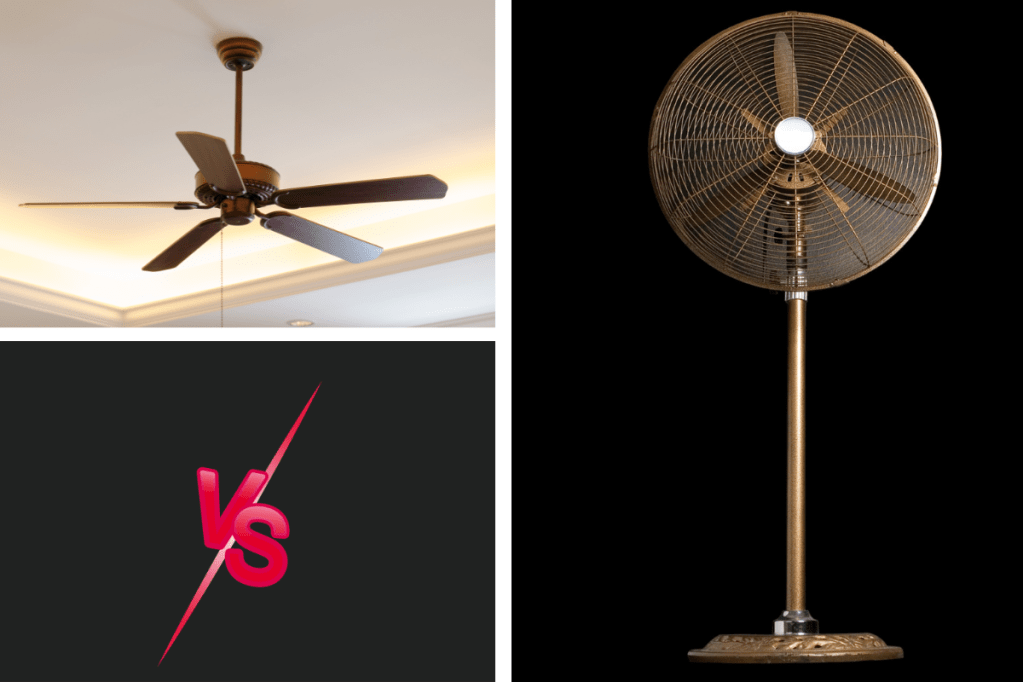
Standing and ceiling fans may be used to ventilate and cool your house or office. All kinds of fans have pros and cons, so which one you select depends on your preferences and the room’s ventilation needs.
Ceiling fans differ primarily in their installation technique. Ceiling fans need more time, labor, and skill than conventional fans since they must be mounted to the ceiling and wired into your home’s electrical system. Standing fans may be moved anywhere by plugging them in.
Yet, ceiling fans’ benefits generally outweigh the installation labor. Ceiling fans disperse air more evenly since they are mounted to the ceiling rather than the floor. Because of this, your air conditioning system may not be needed as much, resulting in better cooling and lower energy expenses.
Standing fans are great for flexible cooling. They are portable and can chill a specific area. This may be handy in places where you need temporary or portable cooling, such a patio or garage, or in smaller rooms where a ceiling fan won’t work effectively.
Another factor when choosing between ceiling and standing fans is their appearance. Ceiling fans come in several styles and finishes to suit any decor. Standing fans might be an excellent alternative for minimalist or industrial-style fans, even if they are less aesthetically appealing.
Ceiling and standing fans vary in price based on size, functionality, and quality. Ceiling fans are more expensive than conventional fans due to the extra labor required to install them and their higher quality and durability.
To conclude, ceiling fans or standing fans depend on personal preference and the space’s needs. If you want more even cooling, a ceiling fan may be preferable. Yet, a standing fan is more flexible and mobile. Now, any fan can cool your house or company efficiently and affordably.
Most households and businesses use ceiling fans and stand-alone fans to cool. With all the circumstances, choosing between the two may be challenging.
Ceiling fans are installed on ceilings and move air at head level. They come in several styles, from modern to classic. Ceiling fans with lights are popular for those who want illumination and cooling in one device. This makes ceiling fans popular.
Standing fans may be moved anywhere the user wants. They usually include height and speed options and are easy to store. Standing fans may be excellent for multi-room or temporary fans.
Ceiling fans cool better. By circulating air, they may make a room seem up to 8 degrees cooler. Standing fans direct airflow toward the user, providing instant comfort.
This circumstance should prioritize pricing. Ceiling fans cost more than standing fans but last longer and use less energy. Ceiling fans also add value to your home.
Installation is another factor. Ceiling fans need professional installation, which may increase cost. Free-standing fans may be utilized right out of the box without installation.
Finally, consider your specific tastes and needs. If you value mobility and convenience of use, a standing fan may be best. If you want to reduce cooling energy waste and invest in a long-term solution, a ceiling fan may be optimal.
Ceiling and standing fans have pros and cons. Your needs and preferences will ultimately decide. While choosing, consider cost, simplicity of installation, cooling efficiency, and convenience.
Nonetheless, ceiling fans circulate air and chill a space. They increase air circulation in high-ceilinged spaces. Ceiling fans come in many styles, shapes, and sizes to match any decor. They circulate more air and chill better than standing fans due to their larger blades.
Ceiling fans need expert installation, which may be costly and time-consuming. They need regular blade cleaning and motor lubrication. Ceiling fans with remote controls or smart home integration may cost more than standing fans.
As ceiling fans don’t vibrate, they’re quieter than standing fans. Standing fans have floor bases. They may emit a soothing, low hum, especially on hot summer nights.
Choosing a ceiling-mounted or floor-mounted fan relies on your needs and preferences. Standing fans are portable and economical, whereas ceiling fans are permanent and beautiful. Standing fans are cheap and portable. Consider the room, ceiling height, budget, and features while making a decision. It doesn’t matter whatever fan you use to stay cool and comfy in the summer.
Ceiling and standing fans may be more energy-efficient and cost-effective than air conditioning. As they circulate air, ceiling fans may use less electricity. This may chill you without using the air conditioner, saving you money.
Your space’s appearance is another consideration. Ceiling fans are popular since they come in many shapes, colors, and materials. They may also be the room’s centerpiece and decorate it. Standing fans, on the other hand, are easy to move and may be placed anyplace.
Finally, consider both fans’ safety features. If touched while the fan is on, standing fan blades are dangerous, and if placed in a trip hazard, the fans themselves are dangerous. Yet, improperly placed ceiling fans or those with defective parts might be dangerous.
In conclusion, both ceiling and standing fans have pros and cons, and the decision depends on personal preference and needs. While choosing, consider the space, budget, features, energy efficiency, aesthetics, and safety. Using a fan to stay cool in summer may save time and money.
Free-standing and ceiling-mounted fans may make noise. Ceiling fans are quieter than standing fans since the engine is above the blades. If you want silence in your home, try ceiling fans.
Standing fans provide movement. They are easy to move, and some have built-in handles or wheels. They are ideal for temporary applications or those who desire fans in many rooms.
Ceiling fans are more permanent than other fans. Installing them takes longer than plugging a standing fan into an outlet. Once installed, they may provide regular air circulation without taking up valuable floor space.
Choosing a ceiling fan versus standing fan depends on personal preference and space needs. When choosing, consider energy efficiency, beauty, noise, mobility, and safety. In the summer, any fan will keep you cool and comfortable.
Another consideration when choosing between a ceiling fan and a standing fan is air circulation. Ceiling fans may pump air around a room to create a gentle breeze, keeping you cool and comfortable. Ceiling fans have larger and more powerful blades than floor fans.
Yet, standing fans may focus and guide airflow to a specific area of the space. Some models include height and angle adjustments to customize airflow direction and intensity.
Energy usage is another important consideration when choosing a ceiling or standing fan. Ceiling fans are more energy-efficient than floor-standing ones. They employ a superior air-circulating engine than a standing fan. Ceiling fans are meant to distribute air across a room, which may minimize your energy expenses by reducing the time you spend in front of the air conditioner.
Ceiling and standing fans come in several styles to fit a variety of houses and spaces. Stand-alone fans come in several colors and materials, making them suitable for any interior design, while ceiling fans add elegance to a room.
In conclusion, choosing a ceiling-mounted or free-standing fan relies on your choices and needs. Consider energy efficiency, air circulation, noise, portability, safety, and aesthetics while choosing. Choose a fan that suits your lifestyle and budget to keep cool and comfortable in extreme temperatures.
 Hey Singapore