
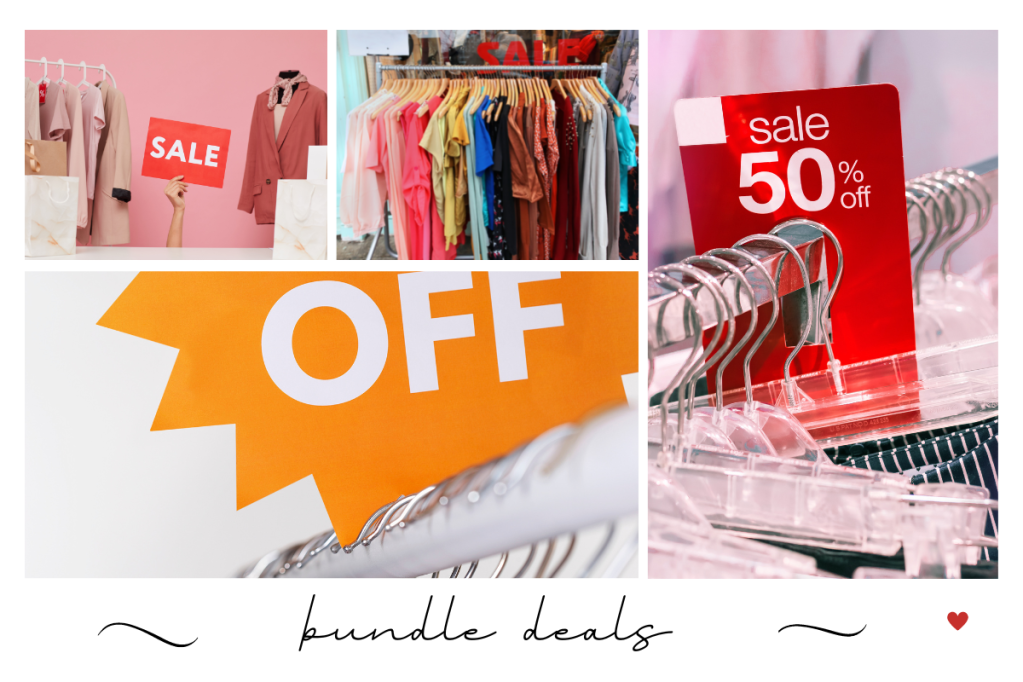
The term “bundle deal” refers to an offer that combines two or more products or services and sells them at a discounted price when purchased together. These discounts are created to encourage customers to make additional purchases, which in turn boosts sales and revenue for businesses. Retail, lodging, technology, and the arts are just a few of the many sectors that often take advantage of package deals. They are advertised as a cheap approach to giving clients more for their money and making their shopping experience more pleasant. Bundling products together and selling them at a reduced price has been shown to be effective as a marketing tactic and has a solid foundation in consumer psychology. The popularity of bundle deals is mostly driven by the concept of perceived value, or the idea that consumers are ready to pay more for a bundle of products than they would for the individual items.
The anchoring effect explains this phenomena by explaining how buyers use the original price of an item as a benchmark against which to judge the value of similar products. The initial perceived value of a bundle deal is greater than the total of the separate parts, making it more appealing to consumers when offered at a discounted price.
In addition, offering more comprehensive and convenient shopping through bundle discounts can boost customer satisfaction. Product bundling allows shoppers to save time and money by purchasing multiple related items in one transaction. Added loyalty and patronage can result from this feature’s practicality.
As a result, it’s safe to say that everyone benefits from bundle discounts, not just the firms offering them. Companies can boost revenue and gain new clients by offering cheap bundles of goods, while buyers appreciate the added value and ease of shopping with these deals. Questioning whether or not you save money by buying products in bundles is what this is all about. We need to go into economics, where the intricate dynamics of cost analysis and demand patterns determine market forces.
A bundle deal is a type of sales promotion in which multiple items are sold together at a reduced price. The idea behind this pricing strategy is that customers will see the total cost of the bundle as being less than the sum of its parts and be more likely to make a purchase. Yet, the perceived value of the bundle pricing in comparison to the real costs of the separate items is the crucial aspect in evaluating the economic feasibility of bundle deals.
According to studies of consumer behavior, shoppers’ irrationality is often on display while evaluating the worth of discounts and special offers. Sometimes, customers may misinterpret a discount to be larger than it truly is. On the other hand, people may mistakenly assume that the bundle package represents a better value because they have exaggerated the cost of the individual components. Because of this, it is essential to evaluate the bundle’s actual value before to making a purchase decision.
In conclusion, buying products in bundles can save you money if the total worth of the bundle is more than the sum of its parts. However, caution should be used and a cost-benefit analysis should be performed to guarantee that one is, in fact, obtaining a decent price. Saving money by purchasing many things together in a bundle has grown in popularity in recent years. When two or more items are purchased in a bundle, the price of each is reduced. But there are ways to make the most of these discounts and save money in the long run.
Finding the best bundle deals requires some preliminary investigation. Check if the bundle’s total price is less than the sum of the parts’ individual prices before committing to it. This will guarantee that the package deal is truly a savings for customers rather than just a gimmick.
Another way to save money with bundles is to simply buy what you need. The allure of a low price can lead you to make impulse purchases of products you don’t need or won’t utilize. It’s possible to save money by buying only the things you need or will utilize.
Another consideration when purchasing a bundle is the products’ expiration dates. Not all package deals are worth it if one of the products expires before it can be used.
Finding package discounts during sales or clearance periods is another method to save money. Sales like this help customers to save even more money by providing deeper discounts on already discounted bundle purchases.
Finally, you need to think about the bundle deal’s product quality. You shouldn’t buy something just because it’s on sale; if the quality is low or it doesn’t live up to your expectations, it’s not a good deal. When deciding whether or not to acquire a bundle, it is vital that you take into account the price as well as the quality of the individual products.
In sum, buying in bulk often results in substantial savings. Bundle offers are a great way to save money, but only if you do your homework, buy only what you need, pay attention to expiration dates, shop at off-peak times, and prioritize product quality. Commercially, bundle discounts originated when sellers offered price breaks for buying multiple items at once. Bundling is nothing new; in fact, railroads were among the first to do it in the 19th century as a way to sell numerous tickets at once.
Bundling products together for a discounted price has become increasingly popular as a method for businesses to boost profits, strengthen relationships with regulars, and simplify stock management as the economy has improved. This idea has progressed as it has been adopted by a wide range of businesses and organizations for use in advertising their wares.
It is the psychological phenomena of “loss aversion,” the idea that people are more driven to avoid losses than to achieve benefits, that is said to explain the success of bundle deals. Hence, buyers are enticed by package discounts because they provide a perception of value and savings that may not be there when making separate purchases.
Bundling has been given a further boost by the rise of e-commerce and digital technology; major retailers like Amazon and Walmart now offer customers a wide variety of bundled products. Because of the rise of social media marketing and targeted advertising, companies may now provide bundles that are more relevant to individual customers.
Bundle deals, which have been around for centuries and are still widely used today, are an intriguing example of a marketing approach that has stood the test of time and proven to be successful for companies of all sizes and in all industries. When executed properly, bundle deals can boost revenues for businesses while also bringing substantial discounts to customers. It’s prudent to draw the inference that purchasing a service or product in a bundle is a smart way to save money and time. Retailers in several sectors have recognized the success of product bundling and expanded their practices to include it. Businesses can provide more enticing discounts on bulk purchases by taking advantage of economies of scale. It’s vital to do your research and compare costs to make sure that package deals are indeed a fair value proposition, as with any other shopping strategy. In short, bundle offers can be a clever and resourceful method to stretch your shopping dollars, but it is still important to exercise caution and research each purchase you make.
 Hey Singapore