
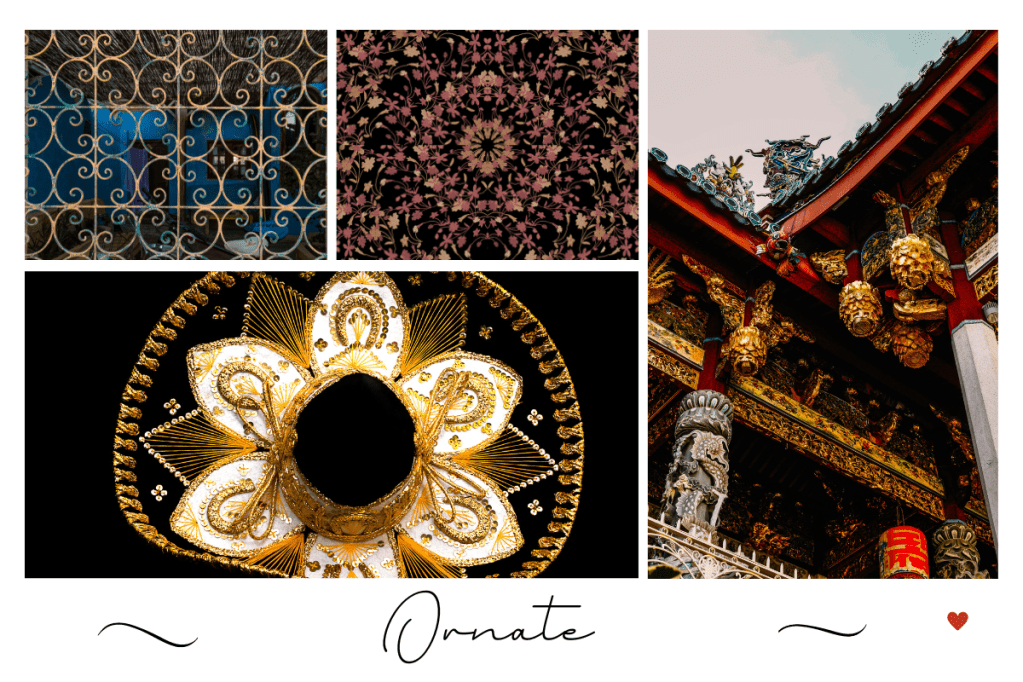
Contemplation on the interpretation of “ornate” invites one to plunge into the sphere of decorative aesthetics. An article, furniture or architectural structure that is considered ornate is often characterized by its intricate and complex embellishments, which serve to enhance and elevate its overall visual appeal. Such adornments may encompass elaborate patterns, meticulous carvings, or decorative motifs, which are typically fashioned using a variety of sophisticated techniques such as engraving, embossing, or filigree work. The ornate style is frequently linked to the Baroque and Rococo periods of art history, which were distinguished by their opulent and highly decorated designs. In contemporary times, the term “ornate” still garners extensive use to illustrate objects or spaces that manifest a high degree of decorative flourish, be it in the form of embellished moldings, intricate fretwork, or highly ornamental textiles.
To behold the ornate’s sheer beauty is to indulge in the luxurious intricacy and sumptuousness of their design. These works of artistry and craftsmanship are lavishly adorned with ornamental flourishes, intricate patterns, and embellishments that inspire a sense of magnificence and refinement.
Each ornate piece is a unique manifestation of the artist’s vision, materialized in precious metals, gemstones, and exquisite woods, and skillfully crafted using techniques passed down through generations of accomplished artisans.
The appeal of ornates extends beyond their aesthetic allure, as they embody the cultural and historical contexts in which they were created. They are a testimony to human creativity, resourcefulness, and sophistication across ages.
Whether it be a gilded frame, an intricately carved piece of furniture, or a bejeweled accessory, ornates exude a timeless fascination that continues to captivate and stimulate devotees of beauty and refinement.
The artistry of ornate objects has served as a muse to numerous poets throughout history, who have endeavored to capture their grace and splendor in their works. Poems celebrating ornate objects can manifest in diverse forms, ranging from sonnets to free-form verse.
Some poets choose to focus on the intricate details of ornate objects, describing the way that light catches the curves and angles of their surfaces. Others may take a more metaphorical approach, using ornate objects as symbols for deeper emotions and ideas.
One recurring theme in poetry about ornate objects is the tension between beauty and mortality. Many poets have noted that even the most ornate objects will eventually decay and crumble, reminding us of the fleeting nature of all things.
Overall, poetry about ornate objects invites readers to reflect on the nature of beauty, craftsmanship, and the passing of time. It encourages us to appreciate the finer things in life, and to find joy in the intricate details that make the world around us so rich and complex.
To trace the origins of ornate, we must delve deep into the annals of history. The art of ornate is said to have emerged in the ancient world, where it was used to embellish various artifacts and structures. Some of the earliest examples of ornate can be found in the intricate carvings and engravings of the Egyptian pyramids and temples.
As time passed, ornate evolved into a more sophisticated form, with the Greeks and Romans employing it extensively in their art and architecture. Ornate also found its way into the decorative arts of the medieval period, where it was used to adorn everything from manuscripts to religious relics.
During the Renaissance, ornate reached new heights of complexity and beauty, with artists and craftsmen vying to create ever more intricate and ornate designs. This trend continued into the Baroque and Rococo periods, where ornate was used to decorate palaces, churches, and public buildings with an abundance of embellishments and flourishes.
Today, ornate remains a popular decorative art form, with contemporary artists and designers continuing to draw inspiration from its rich history and intricate beauty. Whether it be in the form of ornate furniture, jewelry, or fashion, the allure of ornate continues to captivate and enchant us with its intricate and exquisite designs.
To inquire as to the age of ornate art is to delve into a fascinating and multifaceted topic that spans epochs and cultures. The roots of this intricate art form can be traced back to antiquity, with evidence of ornate designs discovered in ancient Egyptian, Greek, and Roman artifacts.
Over time, ornate art has evolved and flourished, finding expression in a diverse range of styles, from the intricate and delicate filigree of the Middle Ages to the bold and exuberant Rococo movement of the 18th century.
Despite its centuries-long history, ornate art continues to inspire and captivate people today, with contemporary artists and designers creating innovative and daring works that push the boundaries of this timeless and endlessly fascinating art form.
Ornate, with its elaborate and intricate designs, has been employed in various fields throughout history for a plethora of purposes. Its multifaceted nature has allowed it to be utilized in a variety of ways, including in architecture, sculpture, furniture, jewelry, and textiles.
The causes of ornate can be attributed to both artistic and practical considerations. In the realm of architecture, ornate designs may serve to accentuate the grandeur and majesty of a structure, while also providing a sense of symmetry and balance. Sculptural works may employ ornate details to enhance the realism or emotional impact of a piece. Furniture and textiles may utilize ornate elements to provide a sense of luxury or refinement.
Additionally, ornate may have cultural or religious significance, such as in the intricate carvings and motifs of traditional Asian temples or the ornate decorations of Christian churches. It may also have functional purposes, such as in the ornate details of armor and weapons used in battle.
Overall, ornate serves as a testament to human creativity and ingenuity, and its enduring appeal has ensured its continued use and relevance in various fields of art and design.
An in-depth comprehension of ornate entails a thorough exploration of the science and artistry behind its creation. Ornate, often considered the epitome of elegance and sophistication, involves intricate and complex patterns that are ornamental in design. The methodology employed in creating these intricate patterns requires an expert level of skill and craftsmanship.
The science behind ornate patterns involves the study of the principles of symmetry and balance. These principles aid in creating designs that are aesthetically pleasing to the eye, while still being practical in their application. The creation of ornate patterns also involves the use of mathematical calculations, which assist in determining the correct proportions and dimensions necessary to achieve a harmonious and balanced composition.
The artistry involved in the creation of ornate patterns is equally significant. The intricate nature of these designs requires a high level of technical expertise, as well as a great deal of patience and dedication. Ornate patterns are often handcrafted, requiring a mastery of a variety of tools and techniques.
The history of ornate patterns dates back centuries, with evidence of its use found in ancient civilizations such as Egypt and Greece. The art of ornate has evolved over time, with various styles and techniques emerging throughout history. Today, ornate patterns can be found in a wide range of applications, from architecture and interior design to fashion and jewelry.
The use of ornate patterns serves both practical and aesthetic purposes. Ornate designs can be used to embellish and enhance a variety of surfaces, adding visual interest and depth to an object or space. Ornate patterns can also be used to communicate cultural and symbolic meaning, serving as a form of visual language.
In conclusion, ornate patterns are a testament to the skill and craftsmanship of the artists who create them, as well as the principles of science and artistry that underpin their creation. The beauty and complexity of ornate designs are a reflection of the intricacy and depth of human creativity, and serve as a reminder of the enduring power of the human spirit.
The practice of ornate is often closely tied to cultural traditions and historical aesthetics, making it a discipline that is inherently linked to the past. Ornate pieces are often created with a great deal of reverence for the historical contexts and cultural significances that inform them, honoring the traditional methods and styles that have been passed down through generations.
However, while ornate is steeped in tradition, it is also a constantly evolving art form that is shaped by contemporary tastes and innovations. Modern practitioners of ornate often blend traditional techniques and motifs with contemporary materials and design principles, resulting in a dynamic and ever-changing field.
Ultimately, whether ornate is seen as purely traditional or as a synthesis of past and present, its enduring popularity and appeal attest to its ability to transcend time and place, offering beauty and artistic expression that resonates across generations and cultures.
The exquisitely intricate and highly ornamental nature of ornate art distinguishes it from other forms of art. Unlike the simplicity of modern art or the realism of classical art, ornate art is characterized by its lavish, detailed designs and richly embellished motifs. It often involves the use of intricate patterns, elaborate designs, and fine details, and requires a great deal of precision and skill in its creation.
Furthermore, ornate art often features highly symbolic elements, such as religious or cultural imagery, and may have a profound spiritual or emotional impact on the viewer. In contrast, other forms of art may be more focused on conveying a message or emotion through less intricate means, such as color or composition.
Another distinction between ornate art and other forms of art is its historical significance. Ornate art has a rich and varied history that spans many cultures and time periods, from the elaborate decoration of ancient Egyptian tombs to the intricately carved Gothic cathedrals of medieval Europe. This long and illustrious history has made ornate art an important and enduring part of human artistic expression.
In conclusion, while other forms of art may have their own unique qualities and significance, the ornate nature of ornate art sets it apart as a highly specialized and revered art form that has stood the test of time.
 Hey Singapore